

Protecting the Oaks: 3 Major Oak Diseases

Oak trees are the pillars of the Midlands landscape. From the sprawling Live Oaks of historic neighborhoods to the towering Water Oaks in our backyards, these trees provide the shade that makes South Carolina summers bearable. However, our warm, humid climate also creates a playground for several serious diseases.
For homeowners in Columbia, Lexington, and surrounding areas, keeping a watchful eye on your oaks is essential. Here are the three most significant diseases currently threatening our local oak population.
Oak Wilt
Oak Wilt is a devastating fungal disease that attacks the tree’s vascular system, essentially "clogging" the pipes that transport water and nutrients. While it can affect any oak, it is particularly lethal to the Red Oak group (like Laurel, Water, and Willow Oaks), often killing them within weeks.
What to look for:
- Sudden Wilting: Leaves in the upper canopy turn a dull green or bronze, starting from the tips and moving toward the base.
- Leaf Drop: You may notice a heavy carpet of green or partially brown leaves on your lawn in the middle of summer.
- Vascular Streaking: If you peel back the bark on a wilting branch, you might see dark streaks in the wood.
Bacterial Leaf Scorch
Unlike Oak Wilt, which strikes fast, Bacterial Leaf Scorch is a chronic, slow-moving disease. Caused by the bacterium Xylella fastidiosa and spread by tiny insects like leafhoppers, it gradually chokes the tree over several years.
What to look for:
- The "Halo" Effect: Look closely at browning leaves. In BLS, there is often a distinct yellow or reddish-orange "halo" or band separating the dead brown tissue from the healthy green part of the leaf.
- Late Summer Stress: Symptoms usually peak in August or September. It often looks like drought stress, but unlike drought, it typically starts on one branch and spreads throughout the canopy over successive years.
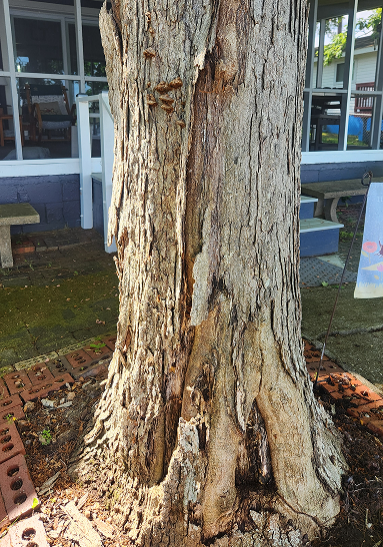
Hypoxylon Canker
Hypoxylon Canker is a fungus that lives dormant in many healthy oaks. It only becomes "active" and deadly when the tree is severely stressed—usually by the intense droughts or root compaction common in the Midlands.
What to look for:
- Sloughing Bark: The most obvious sign is patches of bark falling off the trunk or large limbs.
- Fungal "Mats": Beneath the falling bark, you will see dusty, tan-to-silver fungal mats. Over time, these mats turn black and hard, resembling patches of dried roofing tar.
- Rapid Dieback: Once these mats appear, the tree’s decline is usually irreversible and happens very quickly.

Why Early Detection Matters
The challenge with oak diseases is that by the time a homeowner notices a yellowing leaf, the infection is often deep within the tree's system. Because the Midlands frequently deals with heat waves and fluctuating rainfall, it can be easy to mistake a life-threatening disease for simple "heat stress."
If you notice unusual leaf patterns, thinning in the upper canopy, or patches of bark falling away, do not wait for the tree to "recover" on its own. We strongly recommend reaching out to a local ISA Certified Arborist or a Plant Health Care expert. A professional can provide a precise diagnosis—often through lab testing—and may be able to save your tree through specialized injections, soil amendments, or strategic pruning before it's too late.
Search
Recent Posts

If you’ve lived in the Midlands of South Carolina for more than a single…

If you’ve lived in South Carolina for a few seasons, you know that spring…

If you’re a homeowner in Columbia, Lexington, or Aiken, chances are you’ve seen-or perhaps…

Building your dream home on the waterfront is exciting, but don’t forget the silent…

If you’re a homeowner in the Midlands of South Carolina, from the sandy hills…